Today I’d like to write down what I remember from sessions 21–30 of the educational research and statistical analysis course for teachers, along with some reflections.
1. logit and logistic regression analysis
At first, when I heard “logistic regression analysis,” I thought it was something very advanced, but it turned out to be linear regression that follows the logit.
I didn’t expect the concept of the logit, which I encountered when learning about LLMs before, to appear here as well.

Odds are the probability of an event occurring divided by the probability of it not occurring.
And if you take the log of this, you get the logit.
The reason for using the logit is that the multiplicative rate of increase or decrease in the logit remains constant for a given change in the predictor.
However, because the meaning of the logit graph itself is not easy to interpret, you need to convert it back into odds and then probabilities when interpreting the results.
The way to do this in R is very simple: just take the lm function you’ve been using and put a g in front so it becomes glm.
data <- read.csv(file.choose())
m1 <- glm(Y ~ X, data=data, family = binomial)
2. Lord’s paradox and how to interpret it
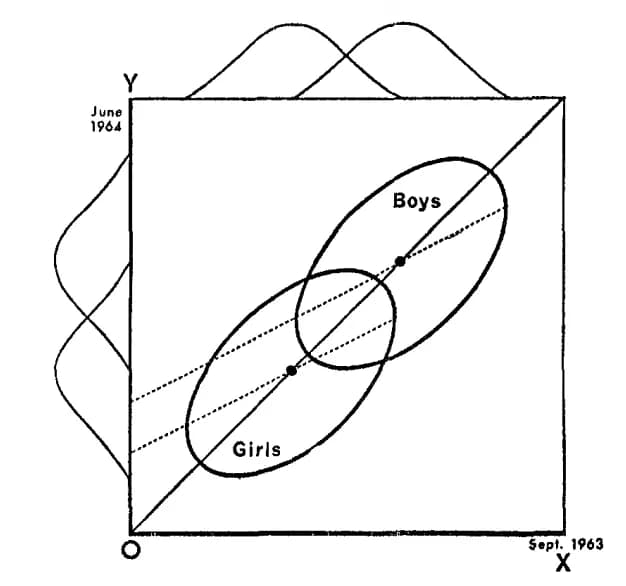
Lord’s paradox is a discussion about how interpretations change depending on the analysis method when looking at weight change graphs for two groups, male and female.
It’s called a paradox because different research results arise from the same data.
One researcher used the two groups to conduct an analysis of covariance (ANCOVA), while another used the difference between final weight and initial weight as the outcome.
This difference stems from the research questions.

The former, using ANCOVA, dealt with “the effect of dieting if men and women started from the same weight,” while the latter dealt with “the average amount of weight change in men and women after dieting.”
In conclusion, the two methods of analysis answer different research questions, and which method is more valid depends on the research purpose and interpretive perspective.
This suggests that in research, you must choose the appropriate method of testing according to the purpose and direction of the study.
3. Final thoughts on the training in educational research and statistical analysis for teachers
When I first applied for the course, I thought it wouldn’t be very different from the research methodology course I took in graduate school, but it turned out to be extremely helpful.
If graduate school covered educational research in general, this online course felt like it zoomed in on the parts needed for writing a thesis and went through them in detail all the way to practical application.
It mainly dealt with statistical analyses related to linear regression, and I feel that, in the end, linear regression is the most practically useful statistical analysis that teachers can conduct.
I also wondered at first why I needed to learn R, but after taking the class I immediately installed R and R Studio.
I can’t do research without R now.

The only downside was that the lecture materials didn’t include csv files, which made it difficult to actually practice statistical analysis in R.
I did get some data from Kaggle and tried it out myself, but for someone not used to this kind of analysis, it might have been a bit hard to follow.

In any case, the course was good.
If someone asked me whether I’d recommend the class, my answer would definitely be YES.
Just taking this one course would be a huge help when writing a thesis.
Lastly, I pray that I’ll be able to write a good thesis this year.




댓글을 불러오는 중...